When I became part of the vintage lighter community roughly a decade ago, petrol lighters constructed from solid aluminum block(a/b) material were firmly situated in their own category of the hobby. More rumors and hearsay than cold hard fact, what was known was nebulous yet firmly entrenched even if fraught with inaccuracies and falsehoods.
There has been a new movement though in the world of these supposed old, trench art lighters that at once happens to explain many fallacies while threatening to light the very hobby on fire at the same time. Arguments and debates within the hobby as well as the name frequently being referenced in Ebay listings and elsewhere beg the question, who is Alberto Polimeni and how did he take over the vintage lighter hobby?
Origins Of The Discussion
When I hear the name Alberto Polimeni my mind immediately goes to this aluminum block petrol lighter I once owned with what appeared to be World War II related engravings. I wasn’t exactly a green newbie at the time but still as today had plenty left to learn about the world of petrol lighters in general and more specifically to this article some of the nuances, fallacies and misconceptions existing around aluminum block petrol lighters and especially those of a WWII motif.
Now, I should probably stop here for some clarifications because there are going to be plenty of things to clarify during and about this conversation we are having.
The discussion about Polimeni lighters has grown now to include many and varying designs and mechanisms outside what I really understood the scope to be at its onset which I believe came about in middle to late 2023. Larry Tolkin, known on various social media outlets including Facebook and Instagram as Larry Lighter, began posting, showing off many different groups of similarly fashioned or designed aluminum block lighters.
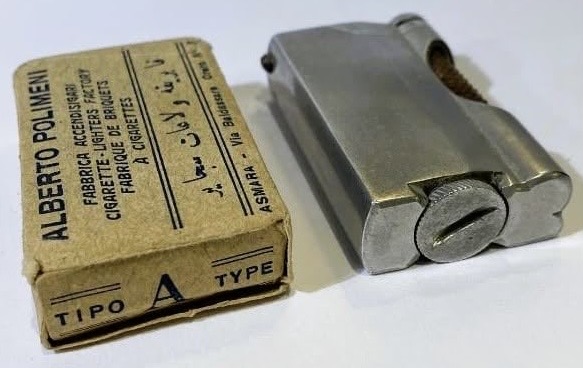
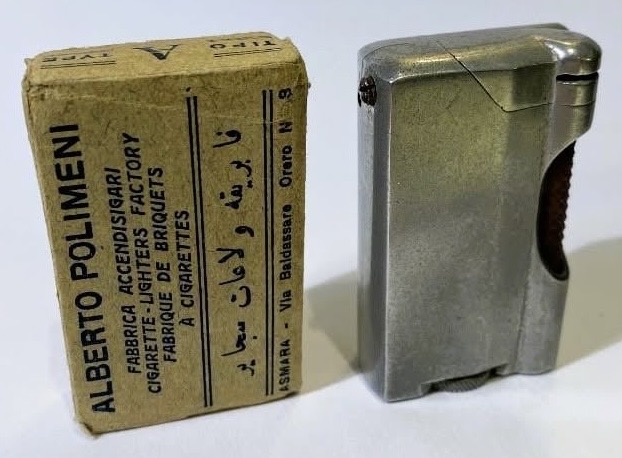
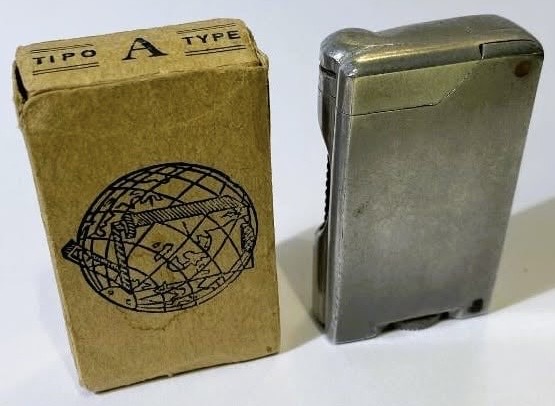
The manufacture of these lighters was attributed in the posts to Alberto Polimeni, apparently based solely on the appearance of a box which was purchased off Ebay containing a similar lighter to many that Larry already had and had begun to analyze and group together accordingly.
Cooler Heads
I think the discussion has also evolved to the point of hyperbolic language being used which is not helpful. Saying things like “Polimeni…world
renowned maker of every unmarked aluminum block example” only heighten the claims to those not understanding the language being used and result in misrepresentations of the claims actually being made.
To my knowledge, Larry Lighter has never made the claim that Polimeni made every unmarked a/b lighter. Not only that but he told me personally that he has never made that claim and only posited that most unmarked aluminum block with perspex lighters along with brass, wood, ivory and other odd materials to be manufactured by Polimeni at his plant in Asmara, Eritrea as indicated on the box.
He makes the same claims for most WWII African theater related trench art engraved type a/b lighters. Larry is eager to dispel the common notion among collectors that these were made by soldiers in their spare time during the war.
Trench Art
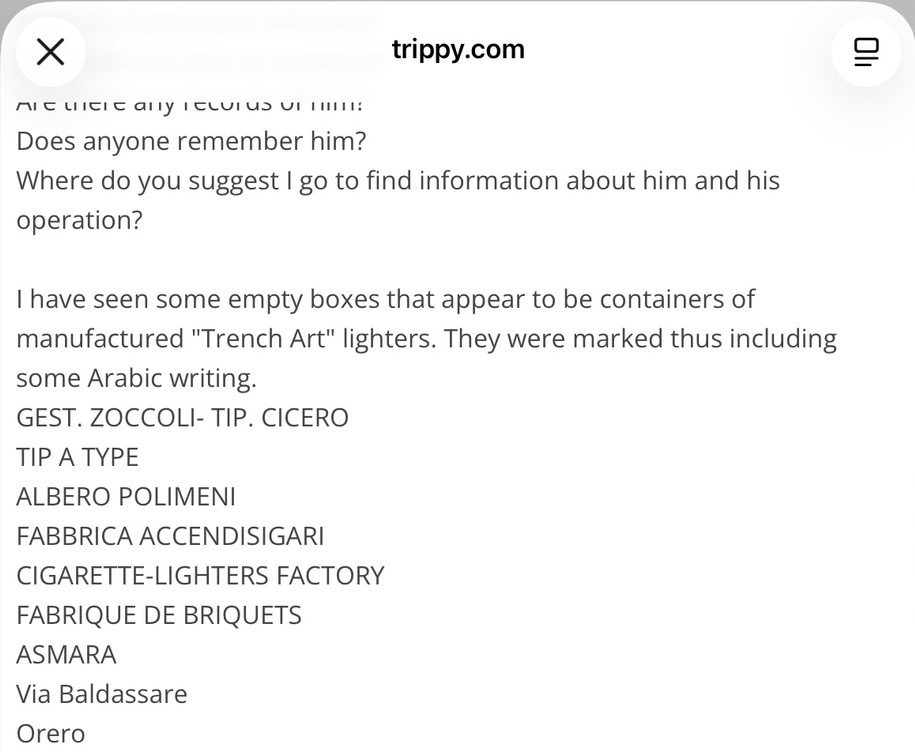
During my research into this subject I discovered an old forum post which seemed to back up some details of Larry’s claim from a website called Trippy where an individual is seeking, “information about Eritrean based Albero(sic) Polimeni, his workshop, or his sales infrastructure.” The poster continues, “He was active in, World War Two and the early 50’s, and he sold cigarettes lighters, cases, ashtrays, and airplane brooches to soldiers in North Africa. The only information I have is from an empty box. He was a prominent designer in the Art Deco style that is prevalent in the regions architecture especially in Asmara, the Art Deco capital of Eritrea, on the Red Sea, His pieces were not signed but some had an inscription, Patent Pending.”
The Trippy post then goes on to list the particulars that are printed on the box, which we will talk about in a moment while also adding, ” I have seen some empty boxes that appear to be containers of manufactured “Trench Art” lighters.” I remember Larry making the claim that none of these supposed “trench art” lighters were actually done in the trenches before I remember hearing the name Polimeni.
There are multitudes and differences, similarities and enigmas when it comes to hunting down the source of unmarked aluminum block petrol lighters. When I first came into the hobby(and it’s still an answer I see often today) many collectors claimed unmarked aluminum block lighters as DIY, at home, beer guzzling in the garage type projects that had apparently just happened spontaneously all across the country. Most were actually “shop” manufactured and some in the U.S. were actually well marked.
Upon Further Review
These are not the lighters that Larry claims to be Polimenis. His claims are much less broad in scope. In fact, he claims that most American and UK manufactured a/b lighters from the 1940s that are marked are actually copies of Polimeni designs.
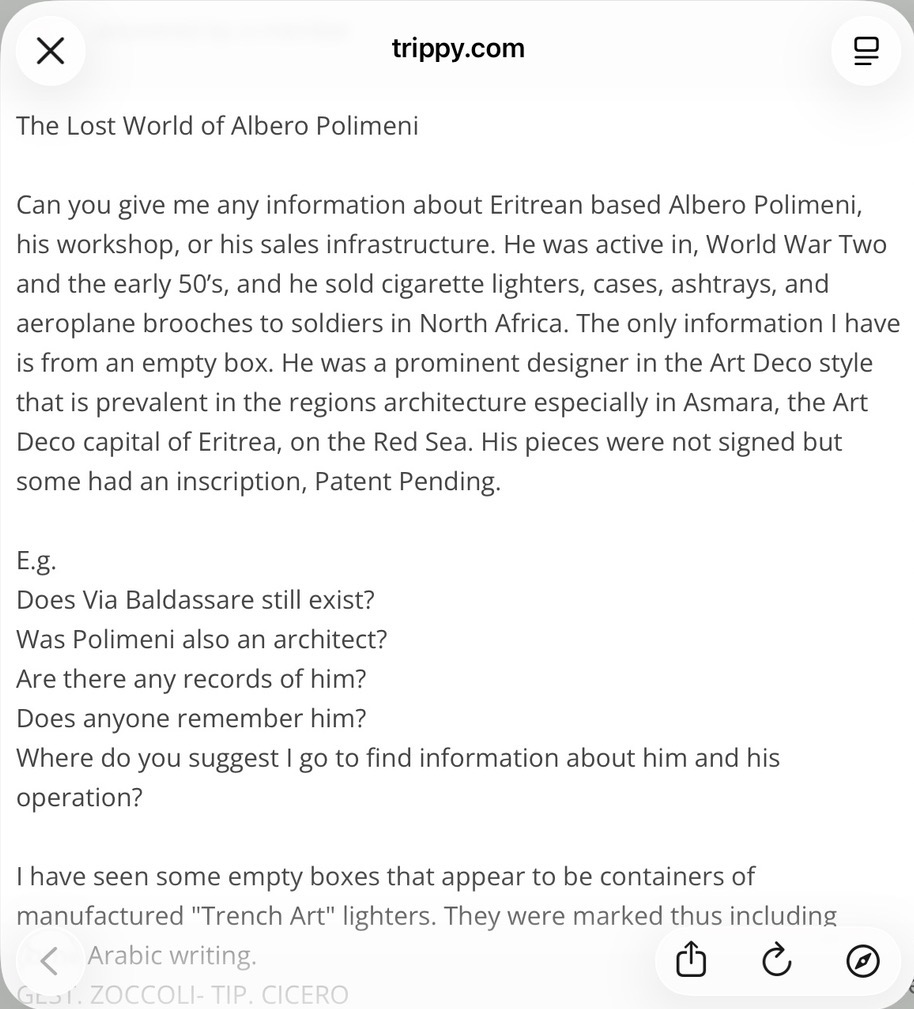
Larry told me that he discovered the lighter in the Polimeni box on Ebay and purchased it in the yr 2000. The trippy post where the user is asking for info about Polimeni’s factory in Asmara based on boxes that had been seen is dated 2006.
The text printed on the box that the Trippy post references reads thus,
“GEST. ZOCCOLI- TIP. CICERO
TIP A TYPE
ALBERO(sic) POLIMENI
FABBRICA ACCENDISIGARI
CIGARETTE-LIGHTERS FACTORY
FABRIQUE DE BRIQUETS
ASMARA
Via Baldassarre
Orero”
This is basically the same information that appears on the box in Larry Lighter’s photo which has circulated among the lighter groups on Facebook and also been published here.
The box in the photo provided in the Vintage Lighters and Matches Facebook group by Eldon Baldwin of the Lighter Library was taken from an angle not seen in Larry’s photo and there is printing that reads “EXCHANGE OFFICER Asmara Barracks Exchange” then the third line starts “ASMARA…” and then is obscured in the photo by the lighter.
Again, this would seem to back up Larry’s claims that these lighters were sold to soldiers stationed in the area through the BX or other typical outlets.
How Did We Get Here?
This is all coming to the forefront in this moment by a confluence of events which include my own curiousity finally getting the better of me and an expert collector named Tom O’Key making multiple Facebook posts labeling
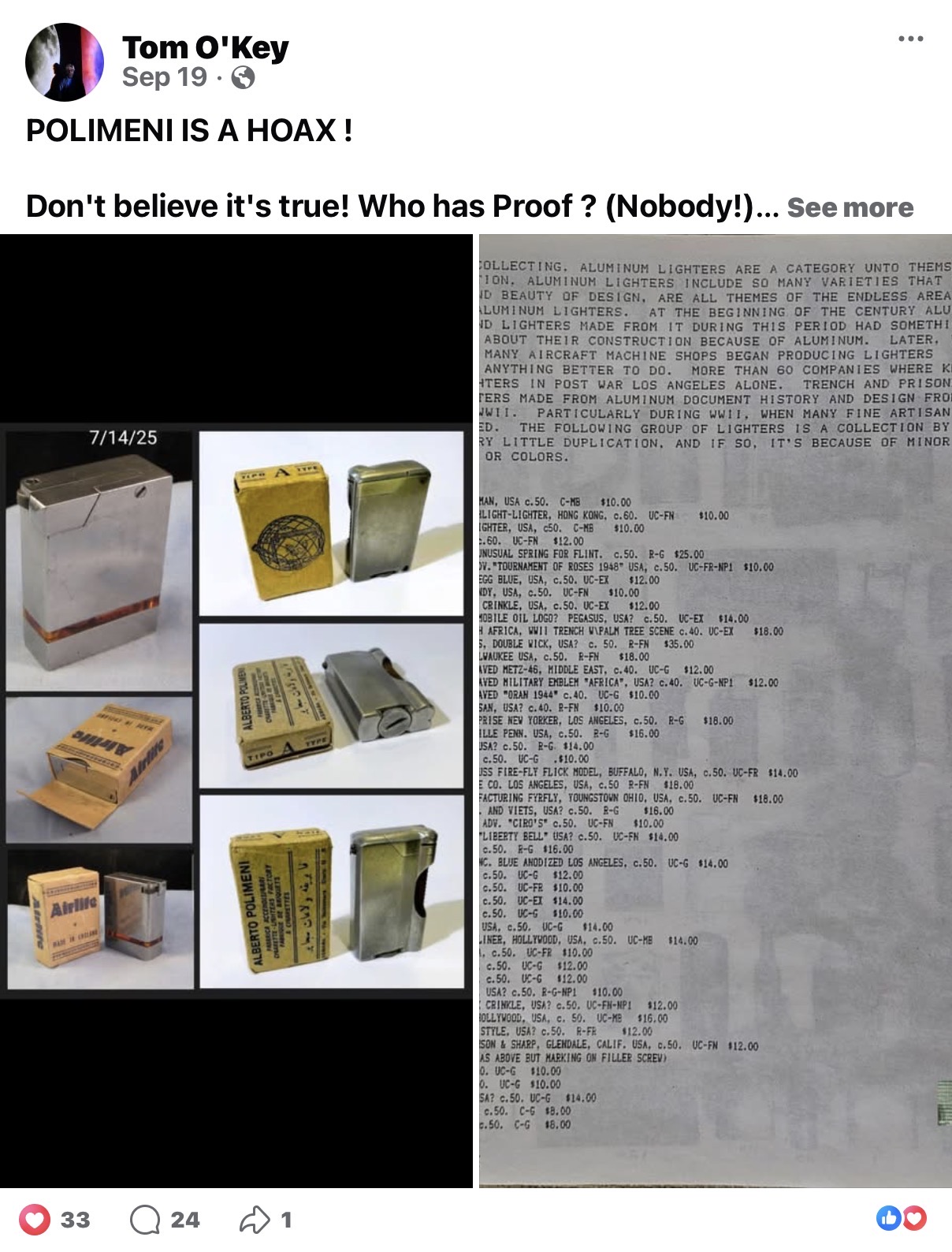
the whole supposed Polimeni saga as a hoax. I started asking questions last week after seeing Mr. O’Key’s latest post and to be honest, I was firmly planted on his side of the argument and believed that at the very least we were dealing with a gross embellishment of what Alberto Polimeni had actually accomplished.
You can’t ignore the boxes and since beginning to write this article and publishing the YouTube video on this subject, I have learned that Larry also says he has a Polimeni table lighter which is boxed but deep out of reach in storage somewhere. So, Larry Lighter apparently has two boxes, Eldon Baldwin of the Lighter Library 1 and then we have the boxes referred to in the Trippy post from 2006.
I just learned over the weekend of another box owned by our friend Nicholas Barth who posted photos from several angles to the DependableFlame.com Facebook group.
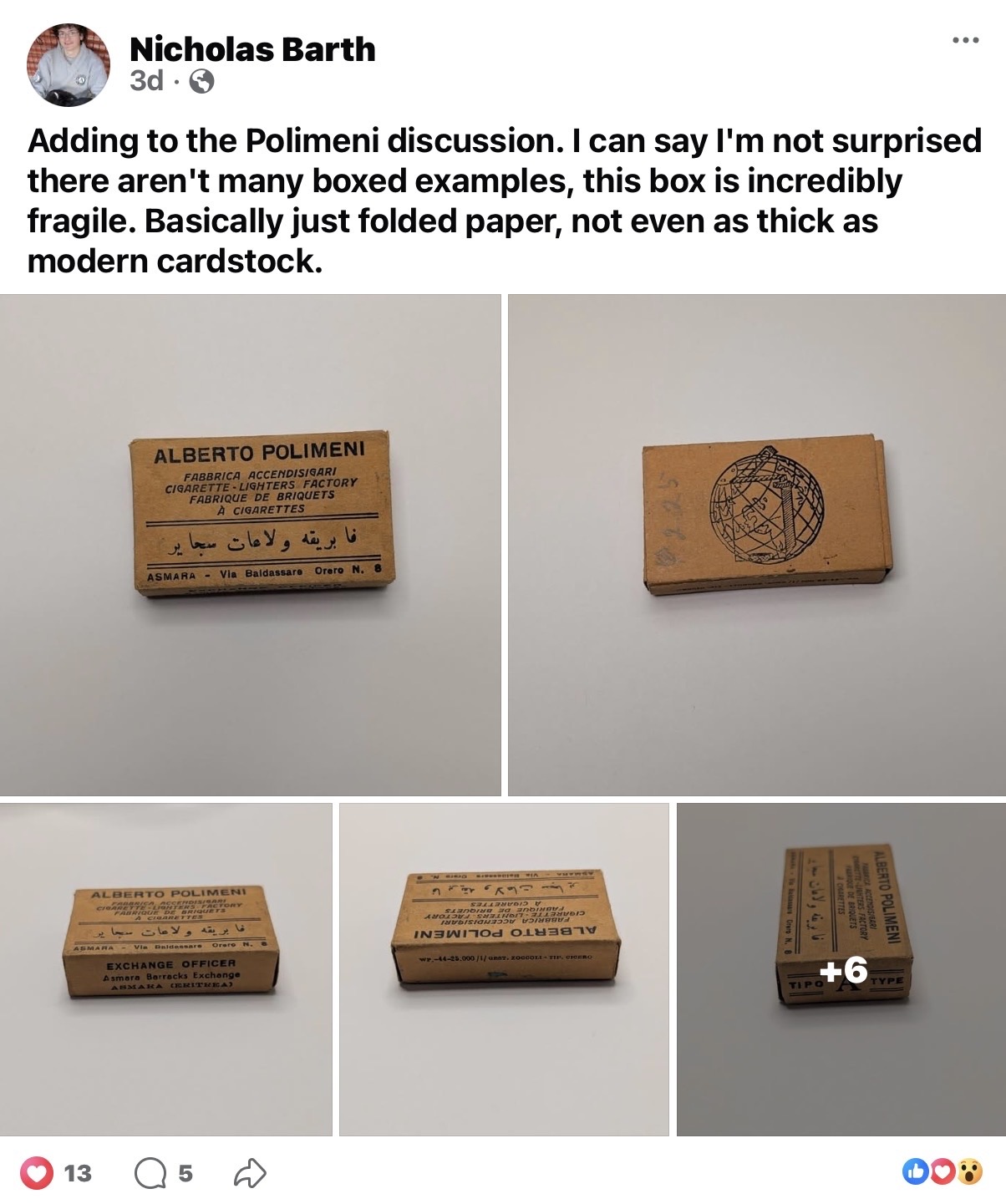
But those boxes prove nothing of the lighters that came in them nor do they actually prove that lighters were ever produced by this Polimeni to put in the box. When I first interacted with Mr. O’Key about this issue he gave me the impression(basically by reading the words that he’d typed) that because there is no Alberto Polimeni listed in the registries of business conducted in Eritrea during the British occupation there that he gave no credence to the boxes whatsoever.
After speaking with him at length on the phone I know that isn’t the case. Tom acknowledges the boxes and their authenticity and might even grant that at least for some of the lighters that have been discovered in those boxes it would be an acceptable term to call them “Polimeni lighters”.
Where Do We Go From Here?
Tom is eager to protect new collectors who may be naive of such claims, not only being made but being stated with an authority that seems to demand deference. This is just my impression but I think if Larry had been talking about Polimeni in the public square of vintage lighter discussion all along the topic might be viewed much differently but as it was Larry only mentioned Polimeni publicly for the first time in 2023, after spending 23 yrs amassing these lighters.
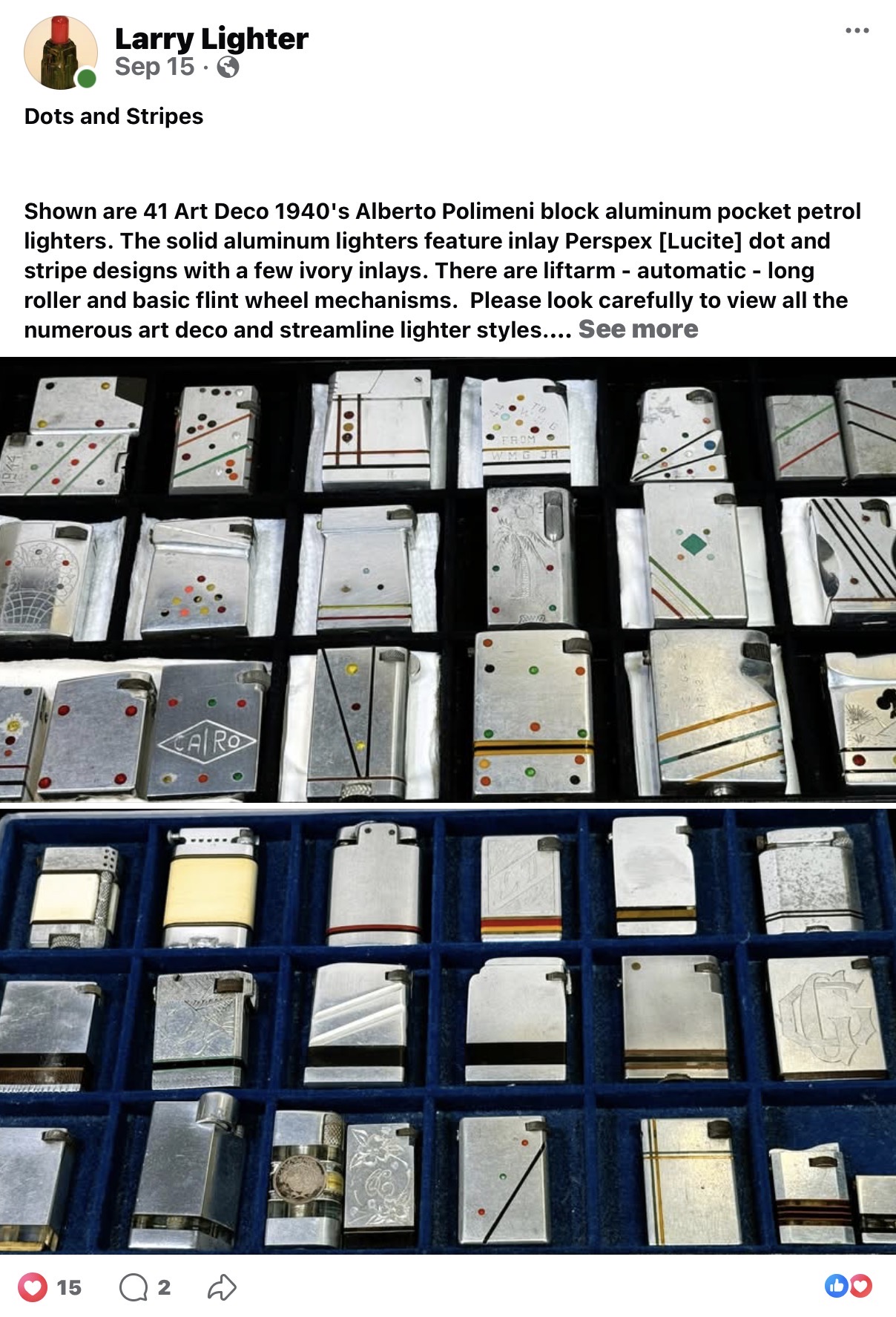
I’m not sure that I can go so far as to agree with Larry on all that he claims to be relics of Polimeni’s Eritrean workshop but looking at the photo of the tray of aluminum block/brass/perspex lighters he sent as an example and reading his explanation of how analyzing these lighters in hand over the course of many yrs enables him to see a connection that others do not see, I can’t call him crazy and I can’t call it a hoax, even if I still would not describe one of these lighters for sale on Ebay as being a Polimeni. Larry offered an invitation to come see all these lighters personally and feel them myself but we’ll see if I’m able to make that happen.
I am afraid that personal, emotional ambition on both sides of this argument may prevent the whole truth and its fantastical reality from ever actually coming to light in a fashion that can be appreciated by the entire hobby. This is a great-big hobby that existed long before I walked in the door and many of its participants have track records of yrs of helpful camaraderie while others spent the time screwing each other over. There is literally no figuring what happened to cause such deep seated resentments, though it does seem they all see each other to be some form of crook at the very least.
The Author Of Polimeni’s Tale
For my part, I’m still not going to be listing these type lighters as Polimenis in my Ebay store anytime soon. I will keep looking and be eager to receive any new documentation that comes to light though because as I see it, Larry Lighter’s stories of Alberto Polimeni and his Asmara factory, while far from being proven, are definitely not a hoax. A hoax would be Larry having printed the box himself and then telling the story to support it.
The evidence for Larry’s claim of Polimeni’s factory being the author of this diverse convergence of lighters obviously rests on much more than him simply finding a box. I believe the box and the name it provided only gave Larry a label by which to categorize a group of lighters he already believed to be related. He has mentioned other factors to me as well including certain markings on some sub-groups of lighters that he attributes to Polimeni as well.
As it is, I believe Larry found a box(as have a few others) and has done the best he could to make sense of it. Thus we have the claim of Alberto Polimeni, his factory in Asmara, Eritrea and his lighters.
Stay tuned…✌️

Joseph,
I found your article to be fairly balanced and weighed with a healthy and justifiable dose of skepticism. While I do have personal thoughts as well as personal history with both “combatants”, I definitely lean in one direction based solely on my “logic” and perspective on the evolution of lighter manufacturing and business generally. I’d be happy to visit this topic with you as it’s like having a debate on who is the greatest ball player of all time, regardless of the specific sport or era. No one can provide definitive proof but it’s always fun to make a case.
Thank you very much Guy, I absolutely appreciate your perspective and would love to discuss this with you anytime. I will reach out to you when I get a chance if I haven’t already heard from your first. Proof is definitely hard to come by but we’ve already discussed a few new pieces of evidence in the Facebook groups that is noteworthy and there is more on the way. It is certainly a fascinating topic. I have always admired your knowledgeable lighter posts on social media and look forward to carrying this discussion forward!
Joseph,
If you send me your email address, I’ll forward you a copy of a rather lengthy observational article I put together. I have this habit of turning short replies into treatises. After you have digested it we can discuss it as well as my personal experiences and interactions with the combatants.
Sounds great!😜 Email is Bossman@DependableFlame.com I look forward to reading it!✌️